
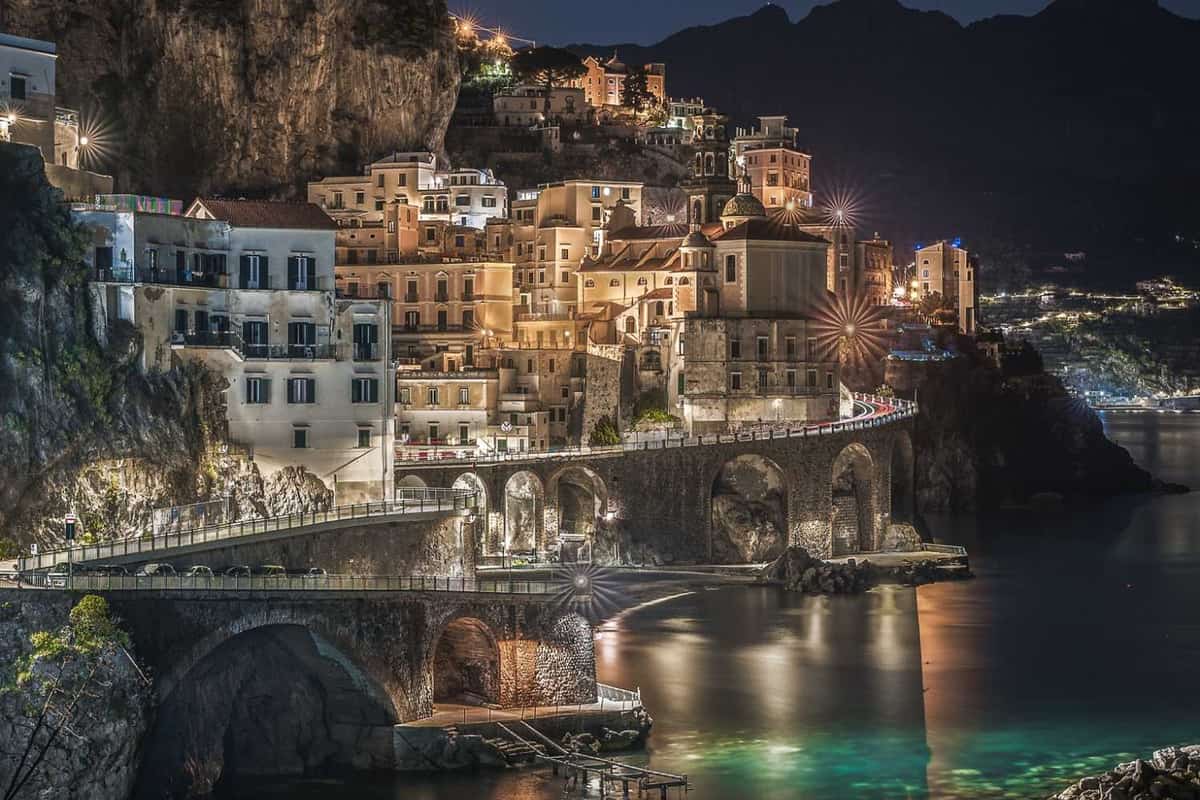
The village of Atrani holds the singular record of being the smallest municipality in Italy, given the surface area of the territory which measures just 0.1206 square kilometres, just over twelve hectares closed between two rock walls and the sea of the Amalfi Coast, in the province of Salerno. Translated into a more familiar unit of measurement, that’s just under seventeen football fields.
Twelve hectares, 751 residents
751 people live in that space, according to Istat data as of 1 January 2026 (an estimate, awaiting the definitive numbers of the permanent census). The density is quickly calculated and it exceeds 6,200 inhabitants per square kilometre, an order of magnitude of a large city rather than a fishing village. The houses, after all, grew up on top of each other. The town retains the medieval layout of alleys, arches, courtyards and “staircases”, the ramps that connect the levels of the town together.
View this post on Instagram
There is no certainty about the origin of the name. One hypothesis leads it back to the Latin ater, darkdue to the shadowed gorge in which the town is nestled, another in Atria, the place from which the first Greek settlers arrived. Since 1997 Atrani has been part of the site Amalfi Coastinscribed by UNESCO in the World Heritage list.
The village that Escher continued to draw
On 25 May 1931 Maurits Cornelis Escher, the famous Dutch artist, was in Atrani and captured his profile in a color drawing. The lithograph arrived in August Atrani, Amalfi Coastin November Dilapidated houses in Atrani. Then the country returned, transfigured, in the series of Metamorphosiswith the first version in 1937, the second in 1939-40 and the third completed in 1967-68 (which we can appreciate below).
@escherinhetpaleis.nl
As reconstructed by the Escher museum in Het Paleis in The Hague, the Dutch artist took more than one liberty: the bridge that in the third Metamorphosis connects the town to the chess pieces, so to speak, never existed.
What to see in Atrani
The heart of the town is Piazza Umberto I, from which a staircase leads up to the church of San Salvatore de’ Birecto. Founded in 940, it was the palatine chapel of the Amalfi maritime republic. Here the doges received their investiture with the «birecto», the cap symbolizing power, and here they were buried.
View this post on Instagram
Inside there is a marble pluteus with two facing peacocks, and the twenty-four panel bronze door commissioned by the noble Pantaleone Viaretta and cast in Constantinople in 1087 is linked to the church. After a long restoration, the building reopened to the public in 2012.
Higher up, on the eastern side, the collegiate church of Santa Maria Maddalena is the image of Atrani that remains in mind. The inhabitants wanted it in the 13th century as a votive church, and today it shows a baroque façade, the majolica dome and the bell tower finished in Escher’s prints.
View this post on Instagram
Next to it, a long staircase leads to the cave which tradition associates with Masaniello, the popular leader of the 1647 revolt. Below is the beach, small and intimate, from which the lamparas still leave in the evening for night fishing. All of this, it should be remembered, in just twelve hectares.
