
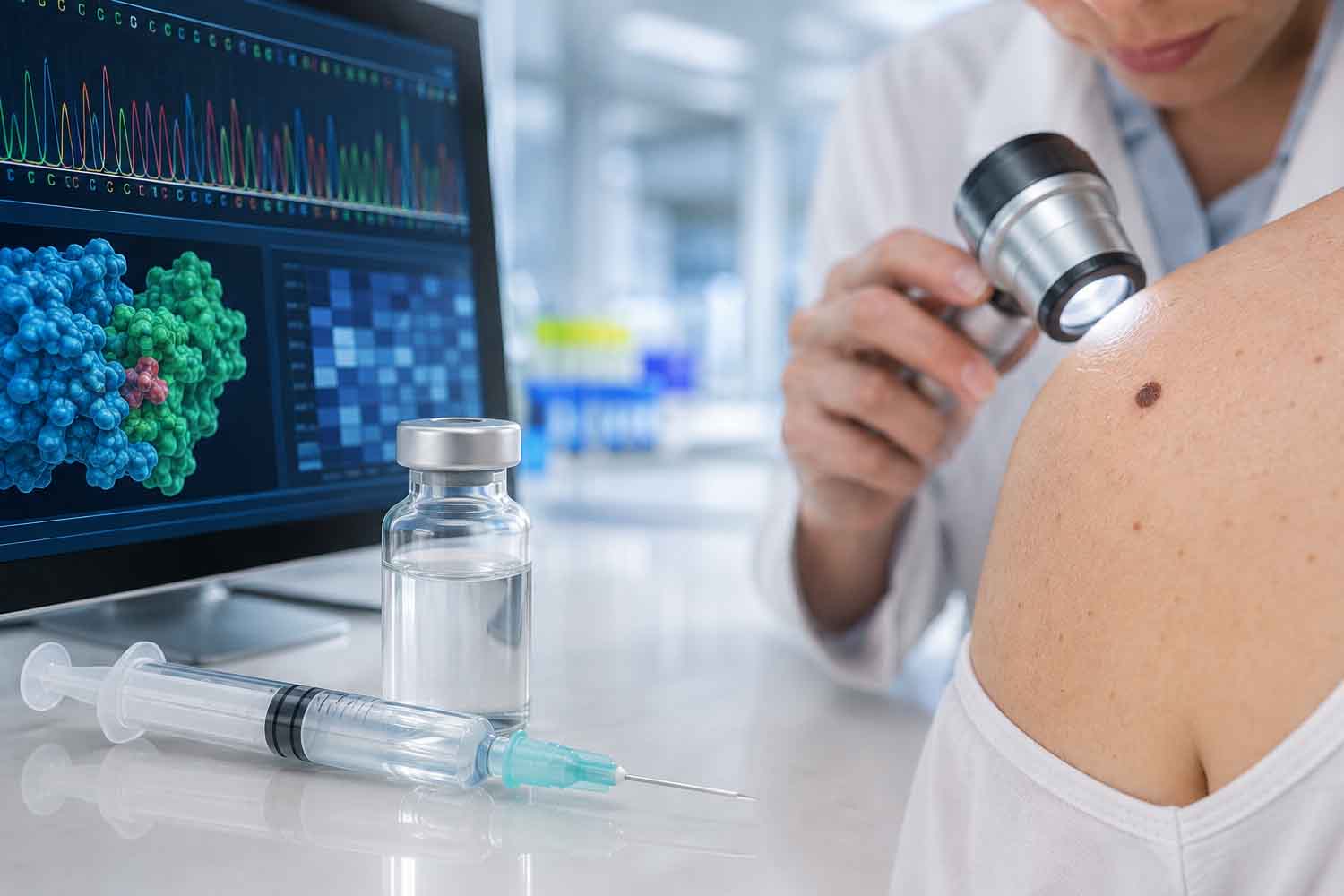
The melanoma is removed, its mutations are analyzed and from that tumor a different treatment is constructed for each patient. Up to 34 molecular targets, chosen on the genetic identity card of the disease and placed inside an mRNA molecule which must teach the immune system what to look for. The so-called mRNA vaccine against melanoma has now reached its toughest test: on August 19, Moderna and Merck announced that the international phase 3 study INTerpath-001 had achieved both the main objective of relapses and that of distant metastases.
It is an important step also because we are talking about the first positive phase 3 result for a personalized cancer therapy based on neoantigens and mRNA. However, there is a rather cumbersome detail to immediately put on the table: the results communicated are for now toplines. We know that the difference compared to immunotherapy alone has been defined as statistically significant and clinically relevant; we don’t know how much yet. The full data will be presented at an upcoming medical conference and submitted to regulatory authorities.
It is not the vaccine used to avoid melanoma
The word “vaccine” can make you imagine a shot administered to healthy people to prevent the appearance of cancer. Something very different happens here.
Autogenous Intismeran, also known during development as V940 or mRNA-4157, is an individualized oncology therapy. In the phase 3 study it was used in people who had already had high-risk skin melanoma, in stages IIB, IIC, III or IV, and in whom the tumor had been completely removed surgically. The goal is to reduce the probability that some tumor cells remaining in the body will be able to restart the disease.
A sample of the individual patient’s tumor is used to build intismeran. Its mutations are analyzed to identify so-called neoantigens, abnormal characteristics of cancer cells that can be recognized by the immune system. An mRNA capable of coding up to 34 is then synthesized. Once administered, it should train the T lymphocytes to recognize precisely those targets.
The treatment is combined with pembrolizumab, an anti-PD-1 immunotherapy drug already used against various tumors. If intismeran provides the immune system with a sort of identikit of the cells to look for, pembrolizumab intervenes on one of the mechanisms by which the tumor manages to slow down the immune response.
And no, it’s not even a single injection packaged and ready for anyone. In the trial, patients assigned to the combination received intismeran intramuscularly every three weeks, up to nine doses, along with pembrolizumab for about a year. Personalized medicine seriously also means this: first you have to read the tumor, then you have to create the treatment.
What phase 3 really demonstrated
The INTerpath-001 study is randomized and double-blind. According to data just communicated by the companies, it involved 1,137 patients, assigned in a two-to-one ratio to the intismeran-pembrolizumab combination or to placebo plus pembrolizumab.
The main objective was recurrence-free survival: how long it takes before the melanoma reappears, locally or distantly, or before death. The combination produced a statistically significant and considered clinically relevant improvement compared to pembrolizumab alone.
A second important objective, distant metastasis-free survival, was also achieved. It means that in the group treated with intismeran plus immunotherapy an advantage was also observed in the time spent without the appearance of metastases far from the original site of the melanoma.
We cannot yet write how great this advantage is. Moderna and Merck did not release hazard ratios, percentages of disease-free patients or number of events observed in phase 3. They also communicated that no new safety signals emerged compared to previous studies, but again detailed data on adverse effects have not yet been made public.
The study will continue above all to clarify another much less ancillary question: overall survival, i.e. to verify whether the treatment can also make patients live longer.
So where do those 49% and 59% come from?
Here it is best to separate two pieces of news that risk ending up in the same blender.
The 49% reduction in risk of recurrence or death and 59% reduction in risk of distant metastasis or death come from the previous randomized phase 2b KEYNOTE-942 study, published in June 2026 in Journal of Clinical Oncology. That study included 157 patients with high-risk melanoma that had already been removed: 107 received intismeran plus pembrolizumab and 50 received pembrolizumab alone.
After a median follow-up of approximately five years, 68.8% of patients treated with the combination were free of relapse, compared to 49.1% in the pembrolizumab group. The risk of recurrence or death was 49% lower, and that of distant metastases or death was 59%. And it is precisely the solidity of these results that led to the much larger experimentation as soon as the first positive result was obtained.
In the same study, 92.2% of patients in the intismeran group were alive at five years, compared to 71.3% in the control group. A notable number, which produced several headlines in June. Overall survival was an exploratory analysis, however, with just 14 deaths overall and a wide confidence interval. The researchers themselves therefore speak of a favorable trend, not of the definitive demonstration that the vaccine reduces mortality.
It is precisely one of the reasons why phase 3 continues.
The experimentation also passed through Italy
Italy entered the international study. The ClinicalTrials.gov register lists among the centers involved the National Cancer Institute Pascale Foundation of Naples, the National Cancer Institute and the European Institute of Oncology of Milan, the Siena University Hospital and the Santa Maria della Misericordia hospital of Perugia.
Intismeran, however, remains an experimental treatment. The phase 3 result does not equate to an authorization and today there is still no ordinary prescription of the “melanoma vaccine”. Moderna and Merck said they will submit full results and discuss applications for approval with regulators. In Europe, the EMA had already admitted V940 in 2023 to the PRIME program, designed to more closely support the development of promising medicines targeting relevant clinical needs. PRIME, here too, means accelerated development and evaluation path: not an already authorized drug.
Meanwhile, the same technology is also being studied in other tumors. The INTerpath program includes trials in non-small cell lung cancer, bladder and kidney cancers, as well as other oncology studies. That’s perhaps the most interesting part of this story: Melanoma could become the first large-scale demonstration that an mRNA vaccine built from mutations in a single person’s tumor can add to an already effective immunotherapy.
To know how much it adds, we will need those numbers that are still missing. But phase 3 has already removed intismeran from the territory of only promises: over a thousand patients later, relapses and metastases have both moved in the expected direction. Now it’s time for the complete data.
