
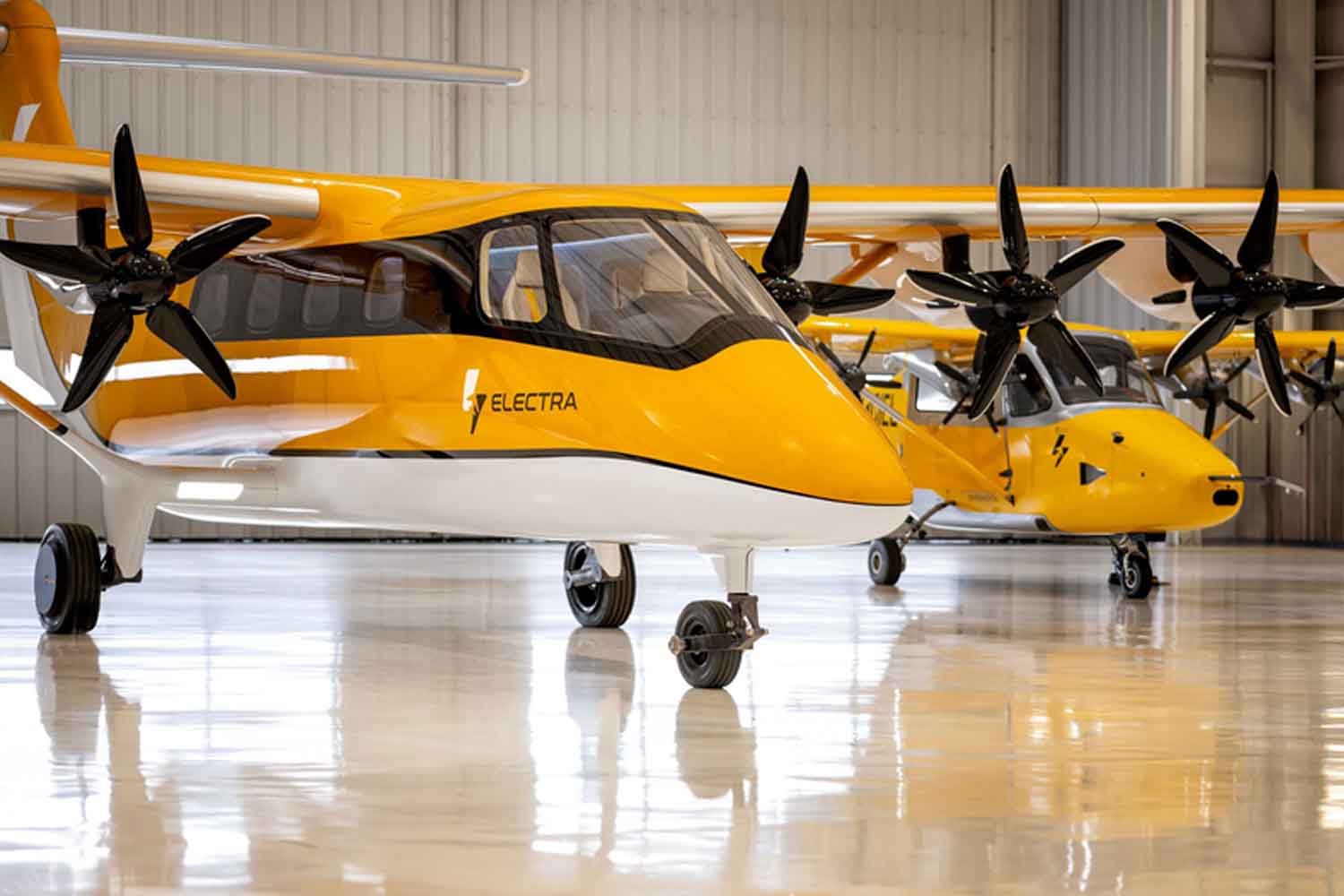
Eight propellers distributed on the wings, a generator in the nose and batteries under the floor. The result is a small plane capable of leaving the ground in an unusually short space. It is Electra’s EL2, the demonstrator born from an MIT university project which has already completed more than 200 flights since 2023. Now that idea is growing: The company is preparing a nine-passenger model and an $850 million factory in Ohio.
The story begins in 2017 within the course Air Transportation Systems Architecting of the Massachusetts Institute of Technology. In those years, eVTOLs, electric vertical take-off aircraft, attracted investments and a lot of attention. The MIT students decided to explore another path: keeping the wings of a normal airplane and using electric motors to drastically reduce the space needed for takeoff.
It is the principle from which Electra was born, founded in 2019 by John Langford with MIT professors Mark Drela and John Hansman as founding technical advisors. From the model tested in the Wright Brothers Wind Tunnel we arrived at the EL2 and now the EL9 Ultra Short, the aircraft destined for commercial production.
Eight electric motors make the wings work harder
The EL9 will not take off vertically. An extremely short runway will be enough for him, at least according to the project and the tests carried out so far. The system uses eight electric motors and as many propellers distributed along the wings: the air is pushed directly over the wing surfaces and flaps, increasing lift when the plane is still traveling at low speed.
It is the so-called blown liftthe same principle already tested with the EL2. In this way Electra aims to make the future EL9 take off and land in approximately 150 feet, just under 46 meters. A distance that opens up scenarios that are quite different from the classic airport runway: the company cites small airports, paved areas, barges and spaces roughly the size of a football field. MIT indicates the possibility of using access points much closer to cities than large airports.
The propulsion system is hybrid-electric. In the EL2 demonstrator a fuel-powered generator is located in the nose, while two batteries are placed under the floor. During take-off and landing, the generator and accumulators can together provide the electricity necessary for the eight engines; once cruise is reached, the generator can power the aircraft and recharge the batteries.
This allows the use of a smaller heat engine than what would be needed to support the peak power required for take-off on its own. Electra thus aims to reduce consumption and noise while maintaining the autonomy necessary for regional connections.
There is also an acoustic advantage that could become important if these planes actually get closer to population centers. Distributing thrust among many smaller propellers allows, according to Electra, to contain noise compared to traditional aircraft with one or two large propellers.
Up to approximately 1,900 kilometers of autonomy
The specifications expected for the EL9 explain why Electra looks above all to trips that today are halfway between car and commercial flight. MIT indicates a cruising speed of around 200 miles per hour, just over 320 km/h, and a range of around 1,200 miles, around 1,930 kilometres.
That value represents the maximum capacity of the design in configurations suitable for the longest routes. For the transport of nine passengers, the planned commercial missions are shorter and focus mainly on regional connections.
Chris Courtin, director of technological development at Electra and one of the students who worked on the original MIT project, identifies the most interesting range as travel between approximately 80 and 400 kilometres. Distances long enough to make the car heavy and often too short that getting to a major airport, going through security and waiting for the flight really saves time.
Electra’s idea is to move some of that traffic towards direct air connections, taking advantage of much smaller infrastructures. A plane could fly passengers to a large hub without necessarily taking up its main runways or directly connect locations that don’t currently have commercial airports.
From university project to an 850 million dollar factory
The transition to industrial scale has already started. On July 21, 2026, Electra announced an $850 million investment to build its first large EL9-dedicated factory in Springfield, Ohio. The project is expected to create 1,975 jobs.
The facility will occupy approximately 96 acres near the Springfield-Beckley Municipal Airport. According to the company’s plans, the first phase will have a production capacity of approximately 400 aircraft per year; with the next expansion it could reach up to 800. Construction is expected to begin in 2027.
The commercial model still faces development, test flights and certification before it can normally carry passengers. The path, however, has already moved from the wind tunnel to a flying demonstrator and now to an industrial plant planned for hundreds of planes a year.
For a project born from some students who were looking for an alternative to eVTOLs, this is a considerable leap. And the starting idea has remained practically the same: use the wings, a few dozen meters of space and much less runway to bring the plane closer to where people really need to leave and arrive.
