
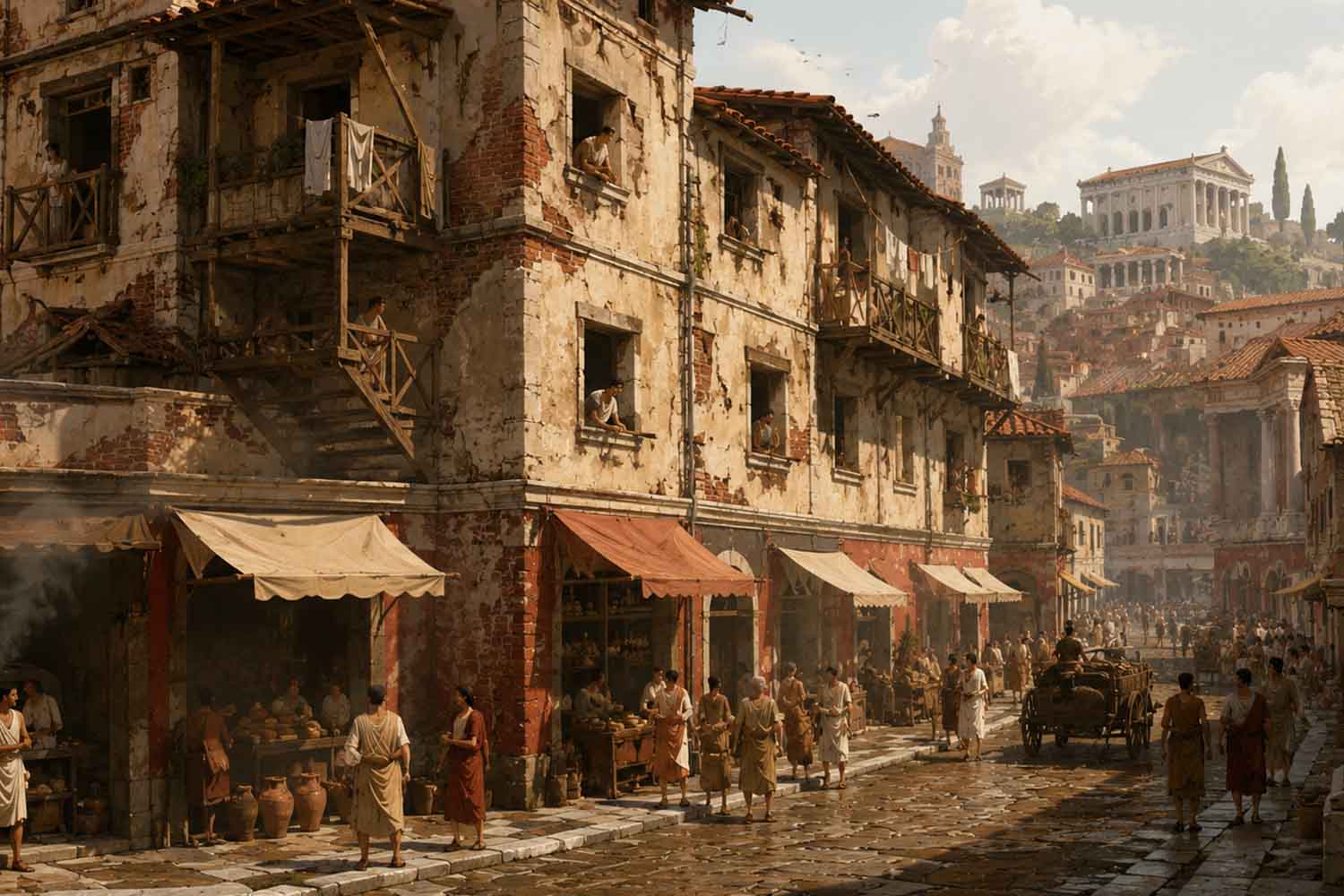
In Rome the condominium arrived long before endless meetings, narrow landings and rents capable of ruining digestion. The imperial city had already understood one practical thing: when people continue to arrive and the space remains the same, you go up. Rooms, shops, families, smells, noises, pots, fears are piled up. You put one life on top of another and hope that the walls hold up.
The elegant image of ancient Rome, made up of villas, columns, internal courtyards and triclinia polished by imagination, concerns a minority. Most of the inhabitants lived in andcollective buildings, often crowded, noisy, built to keep residence and commerce together in the same urban block. The Roman insulae they were this: an ingenious response to demographic pressure and, at the same time, a daily machine of effort, income and risk.
The name already says a lot. In Latin insula means “island”: buildings that occupied entire blocks, surrounded by streets like strips of land amidst human traffic. On the ground floor there were shops, warehouses, stalls and small businesses. The rental accommodation began above. Stairs, landings, rooms. The higher you went, the more uncomfortable life became.
Houses above the shops
The logic of the plans was reversed compared to ours. Today the height promises views, light, terrace, distance from traffic. In ancient Rome, without elevators, height meant tired legs, water to carry up, rising smoke, difficult escape in case of fire. The lower floors were worth more because they were comfortable, accessible, safer. The upper floors went to those who could pay the least.
Many tenants lived in tiny rooms, the cellaewhere an entire family could compress sleep, items, meals and discussions. Elsewhere, especially in Ostia, there were larger apartments, with courtyards, mosaics and reception rooms. The word insula therefore covers very different realities: vertical hovels, mixed buildings with shops and accommodation, urban buildings inhabited by more comfortable classes.
The scale of the phenomenon remains impressive. According to the Regional Catalog of the 4th century, they were counted in Rome 44,850 insulae and 1,781 domus. The numbers must be read with caution, because scholars still debate the precise meaning of the entries, but the report is eloquent: the ordinary city lived mainly in rented buildings.
Rome uphill
Rome attracted people from all over the empire. Workers, traders, artisans, freedmen, clients of the powerful, poor people looking for opportunities, people who wanted to be close to power and grain. There Cura annonaethe public grain supply and distribution system, made the capital even more magnetic. The city reached a size that Europe would see again many centuries later.
All this happened without steel, railways, elevators, modern pumps to push water to the upper floors. The problem was simple and brutal: large population, limited land, slow travel. Vitruvius explained it in De architectura: given the importance of the city and the enormous number of inhabitants, it was necessary to multiply the accommodation and find relief by building tall buildings.
To support that push there was also Roman concrete: lime, water, stone fragments and volcanic ash, especially from the Pozzuoli area and the Gulf of Naples. A very hard mixture, used for ports, spas, amphitheatres, domes, walls and multi-storey buildings. The technique was there. How it was used depended on money, haste, maintenance and the conscience of the owner.
Rent and fire
Where there is a need for a house, income comes. In ancient Rome he arrived with a very recognizable face. Marcus Licinius Crassus, one of the richest men in Roman history, understood that fires could become a business. According to Plutarch, he bought slaves trained as architects and builders, then purchased burned or near-fired homes when panicked owners sold cheap. He rebuilt, accumulated, collected.
Cicero also earned income from real estate. In a letter to Atticus he says that two of his shops had collapsed and the others were cracking; the tenants had left, even the mice had moved out. The phrase is found in the Letters to Atticus and makes you smile just by staying on the owner’s side. For those who lived there, the cracks had a different sound.
The rental market offered poor tenants very few guarantees. We lived month by month, we sublet a room, we made do in increasingly narrow spaces. If something fell from a window and hit a passerby, Roman law at least tried to make order out of the disaster. The actio de effusis vel deiectis was used for damage caused by objects or liquids thrown from a building onto the street: the responsibility fell on whoever occupied the accommodation, even when the thrower was a guest or a slave.
Cracks and stairs
Roman authors knew well the material side of that life. Juvenal, in Satire III, describes a Rome supported by props, with patched buildings and owners ready to cover the cracks while inviting tenants to sleep peacefully. The tone is satirical, the fear was concrete.
Building collapse was a real threat. Added to this was fire. The insulae could contain wood, internal stairs, beams, fragile attics, oil lamps, braziers, improvised kitchens, crowded rooms, narrow streets. Vitruvius hated lattice and clay structures because they were quick and cheap, but easy to set on fire. Savings, in a dense neighborhood, could become ash for everyone.
Augustus established the vigiles, also responsible for fighting fires and night surveillance. After the great fire of 64 AD, Nero imposed new building regulations. Suetonius says that porticoes with terraces were provided in front of houses and apartments from which to fight the flames. For those who lived high up, however, every fire that started from below remained a dirty ride: smoke on the stairs, narrow exit, attic far from safety.
Without privacy
Life in the insulae had little intimacy. Windows were often simple openings closed by shutters or curtains. Glass was expensive and belonged mainly to rich homes. The light entered together with the noise, the smells, the looks. A thin wall divided the families, a common staircase mixed everyone.
On the upper floors there was often no running water. As Britannica also recalls, the inhabitants of the upper levels depended on public fountains and common services. The water had to be loaded, transported and paid to porters when possible. Every domestic gesture had a physical weight.
Cooking at home could be uncomfortable and dangerous. Many bought ready-made food in thermopolia, street places with built-in counters and containers, where hot meals were served. The baths were used for washing, the fullonicas for laundry, the taverns for eating and drinking, the street for meeting. The house was a minimal base. The city served as kitchen, corridor, courtyard.
Then there was the dirt. Chamber pots were used at home. Some emptied them by going down the stairs. Others preferred the window. Juvenal insists on shards, containers, liquids and objects that fall from above. The law came later, when something or someone had already fallen.
The price of the city
Ostia shows the tidiest version of the model: in the House of Diana, built in the Hadrian age, there were shops on the street, a porticoed courtyard, geometric mosaics and articulated apartments. The best preserved buildings, however, above all tell of the robust bones of the past. The worst structures disappeared first.
Rome built vertically because it had to. An enormous population pressed on finite land. The workers had to be close to the work, the shops to the customers, the State to a crowd to be fed, counted, monitored. The Roman insulae they allowed the city to function and allowed someone to get very rich. The same height that made Rome possible made certain lives more fragile.
On a gravestone outside the city, the former slave Ancarenus Nothus left an epitaph that became famous as the tenant’s lament:
In death, finally, no hunger, no rent deposit, just eternal, free housing.
The insulae were an ancient response to a problem that is still alive: living close to opportunities is expensive. Then you paid by climbing ladders, breathing smoke, dodging shards, sleeping under patched cracks. Today we have other materials, other contracts, other upper floors. Rent, on the other hand, has always had a long memory.
