
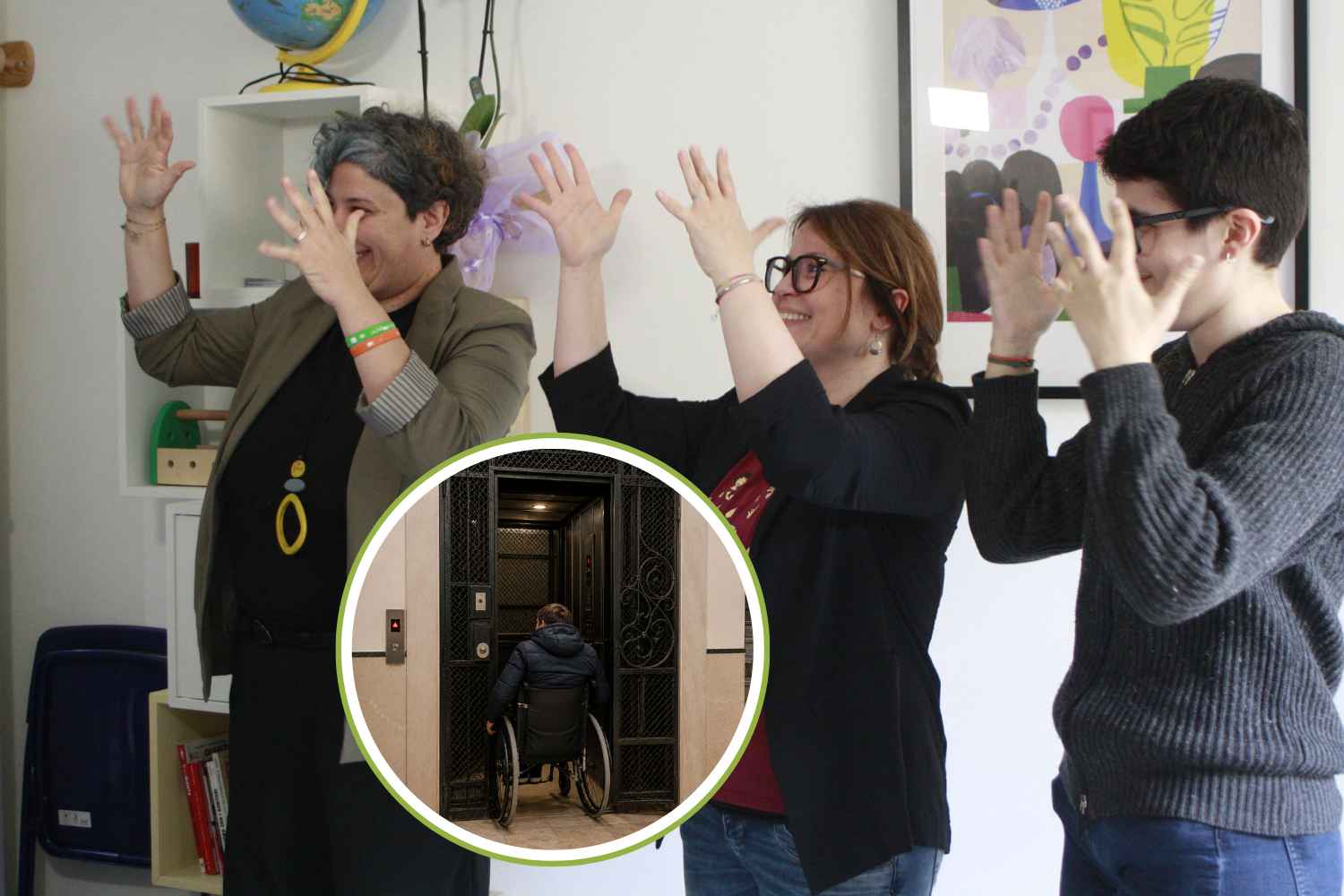
Talking about inclusion during a conference, or making it a nice social media hashtag, is easy. Living it every day, among the stairs, elevators and bathrooms of any city building is a completely different matter. “Io se I can KOMUNIC” knows this well, an association that for years in Rome has been accompanying children with intellectual disabilities and serious communication difficulties through educational, inclusive and rehabilitative paths with the aim of restoring to every person the fundamental right to express themselves, be understood and interact with the world.
After the natural expiry of the rental contract for its historic headquarters, the association found itself faced with what should have been a normal logistical step: looking for a new reception and therapy space. But what should have been the simple search for some suitable room has turned into a bitter obstacle course that almost no one notices, until they experience it first hand.
When the problem is not finding a space, but finding a door
Large, bright rooms, suitable for individual and group therapies: there are several of these in a city like Rome. The real obstacle was another, much more elementary one: finding a place where a person with a disability could enter without help, simply through the front door. This was the truly titanic undertaking: the real estate offered by the capital of Italy presented itself with its most exclusionary face: dozens of places visited, continually rejected due to the presence of insurmountable steps, lifts too narrow for a wheelchair or completely inaccessible bathrooms. As Valentina Colozza, President of the association, told us:
Every time we found ourselves faced with the same question: how can we talk about inclusion if spaces continue to exclude? We tell these families every day that it is society that has to adapt to people, and not the other way around. But then reality comes to test you.
Faced with the impossibility of finding a studio already free of obstacles on the market, therefore, the association took a courageous and principled decision: choosing a structurally suitable location, taking on the commitment to renovate it from top to bottom to make it 100% accessible to everyone.
We’re not talking about aesthetic finishes. We need a compliant lift and a bathroom redone from scratch, designed to be used independently and safely by anyone. These are important jobs, with costs that a small third sector organization can hardly support on its own.
And this is where the topic broadens, becoming something that concerns us all. A sustainable community is not only measured by urban greenery or reduced emissions: it is also measured by its ability to leave no one behind. The removal of architectural barriers is, in all respects, a form of social sustainability, as much as planting trees or reducing plastic.
To make the work a reality, the association launched a crowdfunding campaign on the GoFundMe platform with a clear objective: to transform that new space into a safe home, open and accessible to everyone, no one excluded.
Supporting this cause means transforming the words of the conferences into real bricks, guaranteeing dozens of boys and girls the right to continue to communicate and grow. Contributing, even with a small amount, means helping to build a space that will not only be useful to those who travel in a wheelchair, but also to the parent with the stroller, to the elderly person with difficulty walking and, sooner or later, to each of us.
Because, after all, inclusion does not begin in therapy. Start at the front door.
