
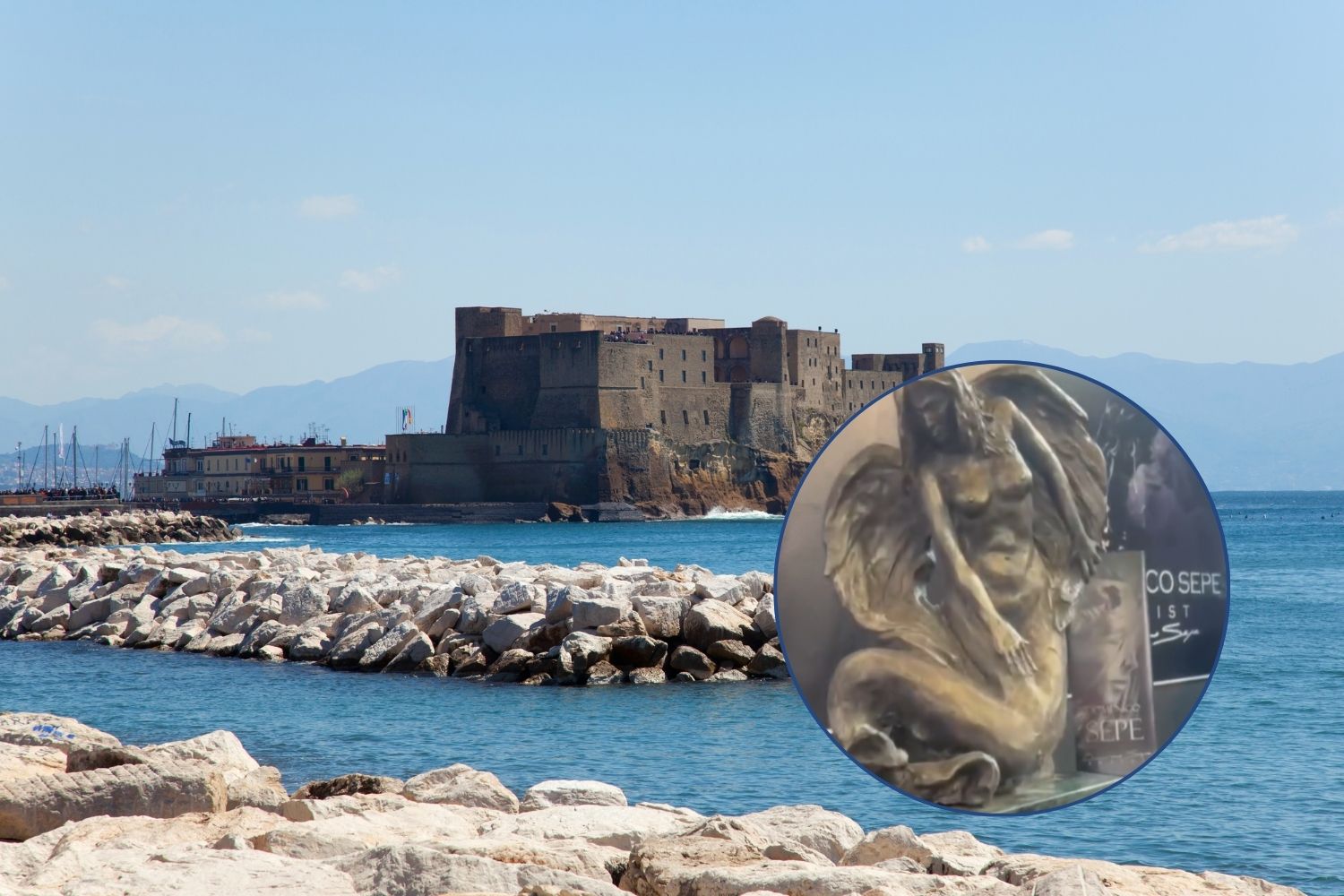
There are cities that keep their treasures in museums. And then there is Naples, which has chosen to entrust them to the sea. In front of Castel dell’Ovo, where legend has it that the mermaid Partenope landed, the city’s first underwater museum is about to be born. A place where art, myth, research and biodiversity meet beneath the surface of the water, transforming the seabed of the Gulf into an open-air gallery. Or rather, in the open sea.
A few meters from the crates in which wines and other food products are aged, 12 works of art will be immersed: ten sculptures by the Neapolitan artist Domenico Sepe and two of Amedeo Sanzone.
The project is “Demersa Parthenope” and is a tribute to the mythological figure from which the city was born.
A museum under the sea dedicated to Partenope
The works will be located between 28 and 35 meters deep, in a stretch of sea already used by a company that deals with the underwater refinement of wines, liqueurs, vinegars and other products. The idea is as simple as it is fascinating: transforming a place of oenological experimentation into a permanent cultural space, where the sea becomes an integral part of the work.
View this post on Instagram
Domenico Sepe’s sculptures, made of bronze and aluminium, reinterpret the iconography of the Parthenope mermaid. Materials that, underwater, completely change their appearance. The two works by Amedeo Sanzone, however, belong to the project “Noumena” and are inspired by the thoughts of Immanuel Kant, imagining light and floating forms that evoke what exists beyond human perception.
Who can visit the underwater museum
Obviously not just expert divers. Those who have the license will naturally be able to dive together with local diving clubs and observe the works directly on the seabed. But an alternative accessible to all has also been designed: visitors will be able to reach the area by boat and observe the sculptures through images transmitted in real time by an ROV, an underwater drone capable of exploring the seabed.
A virtual tour will also be available for schools, museums and cultural entities, so as to make the experience accessible even to those who cannot reach the site.
The entire operation will involve Mare Nostrum of Archeoclub d’Italia, the Solinav technical department and also the children of the juvenile penal area of Naples, engaged in a path of training, legality and social inclusion. A concrete way to demonstrate how culture and regeneration can walk together, along the same trajectory.
Naples is a city that has always lived in symbiosis with the sea. This time, however, he doesn’t just look at it: he transforms it into an exhibition space, a research laboratory and a meeting place between contemporary art and nature.
And perhaps this is precisely the strength of Demersa Parthenope: remind us that the sea is not just a postcard backdrop or a resource to be exploited, but a living heritage to be known, respected and told in new languages.
