
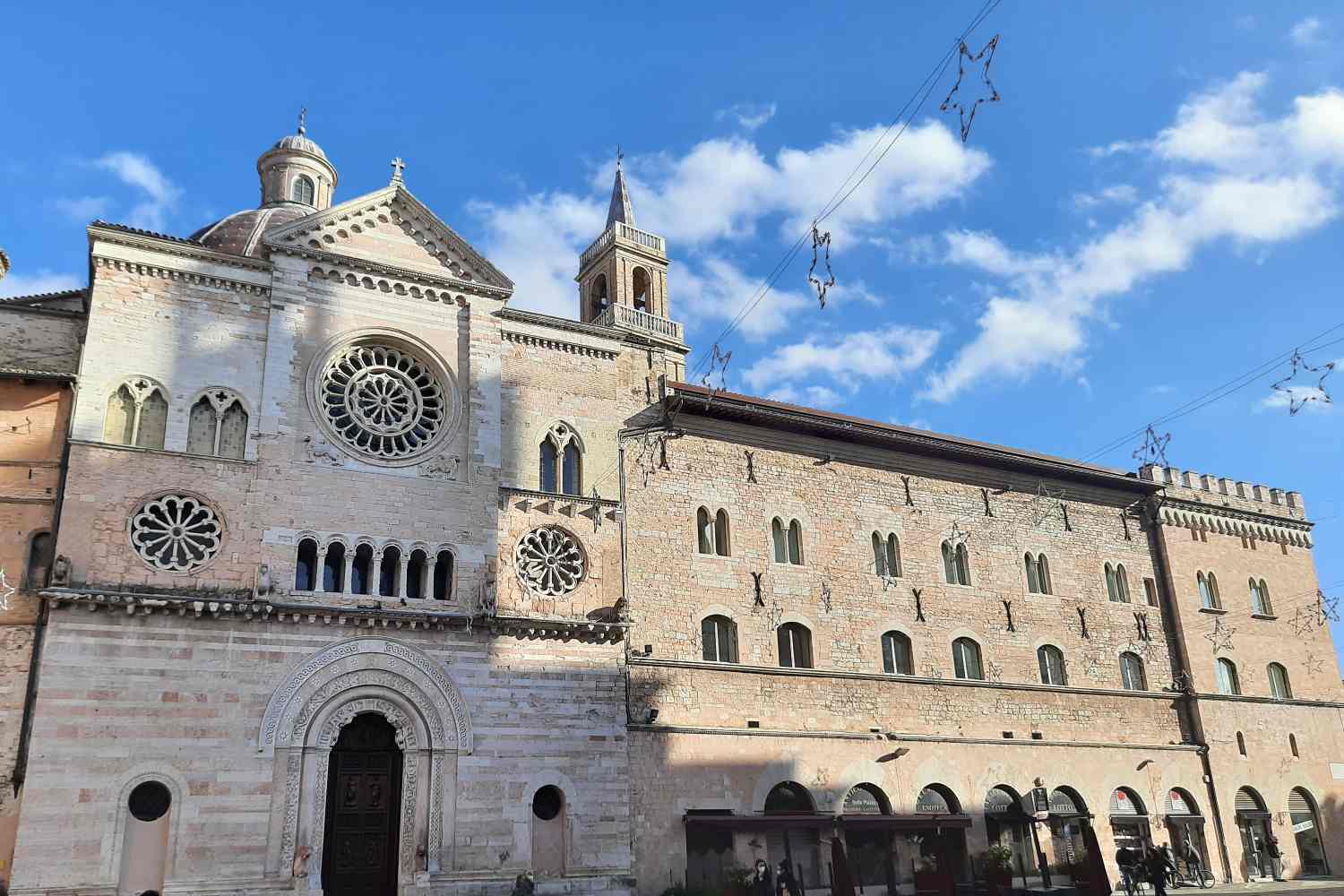
During one of our trips to Umbria, a region that I love and that amazes me more and more every time I visit, we walked along the banks of the Topino river to explore Foligno, a flat gem that breaks the mold of the classic Umbrian hill villages to offer itself as a lively cultural laboratory.
The inhabitants call it with pride “lu center of lu munnu” (the center of the world), a record traditionally located in the exact point where the old Gran Caffè Sassovivo stood in Corso Cavour 60, today marked by a crystal in the floor. But beyond the geographical legend, this city boasts an incredible tradition linked to printing, as well as an artistic heritage that ranges from late Gothic to the most enigmatic contemporary.
Republic Square and the Town Hall
Our journey begins from Piazza della Repubblica, the ancient medieval forum where Saint Francis of Assisi performed the historic gesture of selling his horse and his goods to restore the church of San Damiano.
@RebeccaManzi/GreenMe
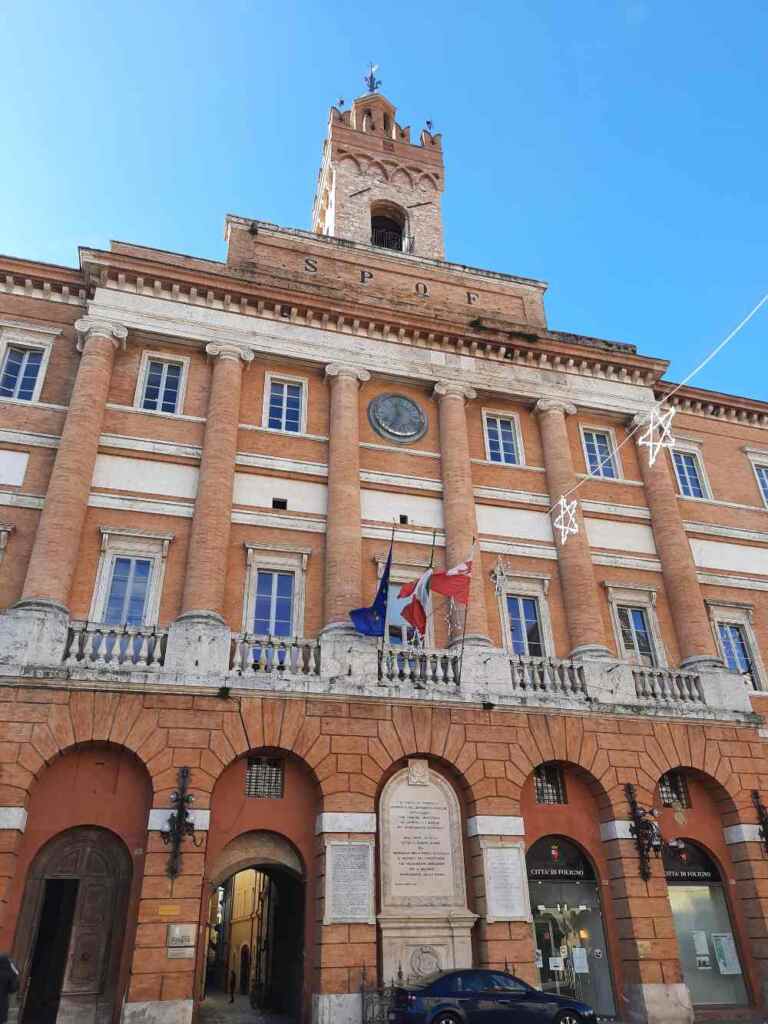
The majestic Palazzo Comunale overlooks the square, a thirteenth-century building profoundly renovated over the centuries and characterized today by a neoclassical façade, unfortunately famous for the collapse of its bell tower during the 1997 earthquake and subsequently rebuilt. Next door stands the Palazzo del Podestà, the historic fulcrum of city assemblies in the municipal era, which houses the suggestive and ancient “well of miracles” nearby.
@RebeccaManzi/GreenMe
Palazzo Trinci and the chapel of Ottaviano Nelli
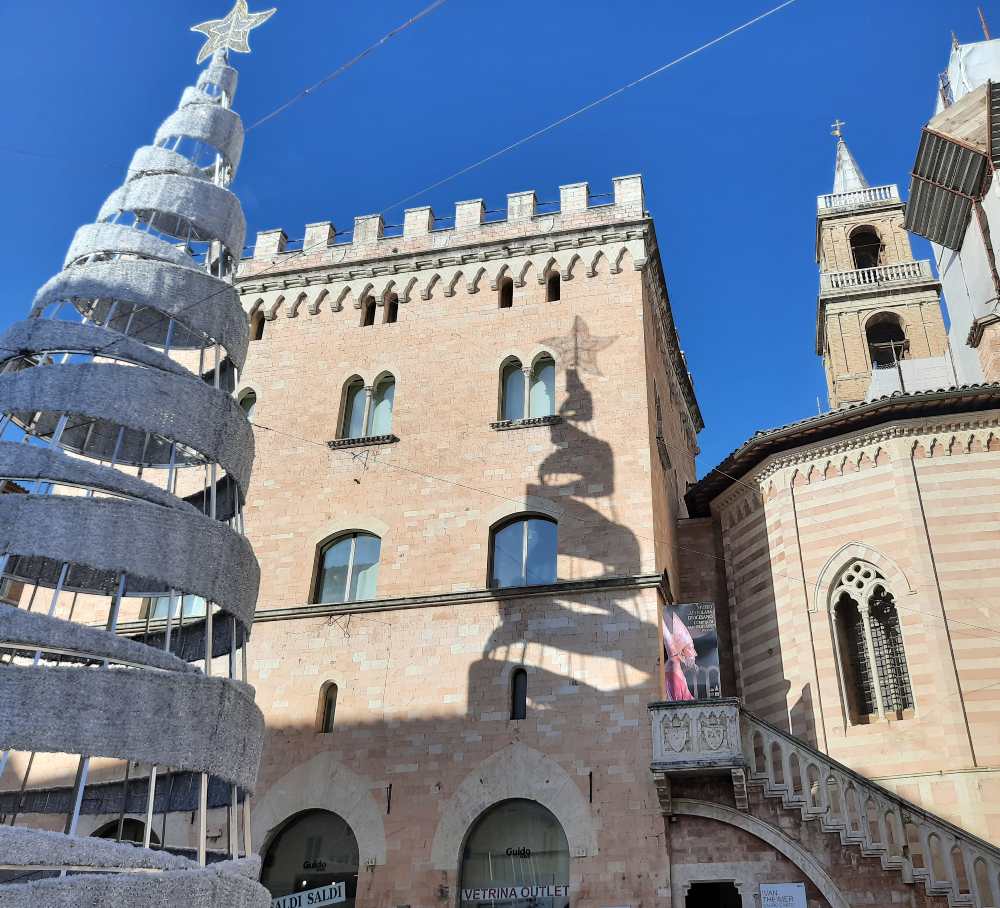
The true wonder of the square is Palazzo Trinci, the sumptuous residence of the lordship who governed the city between 1305 and 1439. Crossing the threshold you are greeted by a splendid Gothic staircase decorated with geometric motifs which leads to the noble floors. Here you are amazed in front of the frescoes by Ottaviano Nelli in the internal chapel, dedicated to Stories of the Virginand to the decorative cycles of Hall of Liberal Arts and Planets. Today the structure is a museum center of excellence which houses the Civic Art Gallery, the Archaeological Museum and the Giuseppe Piermarini Hall, an architect from Foligno who designed the Teatro alla Scala in Milan.
@RebeccaManzi/GreenMe
The Cathedral of San Feliciano and the busts of Bernini
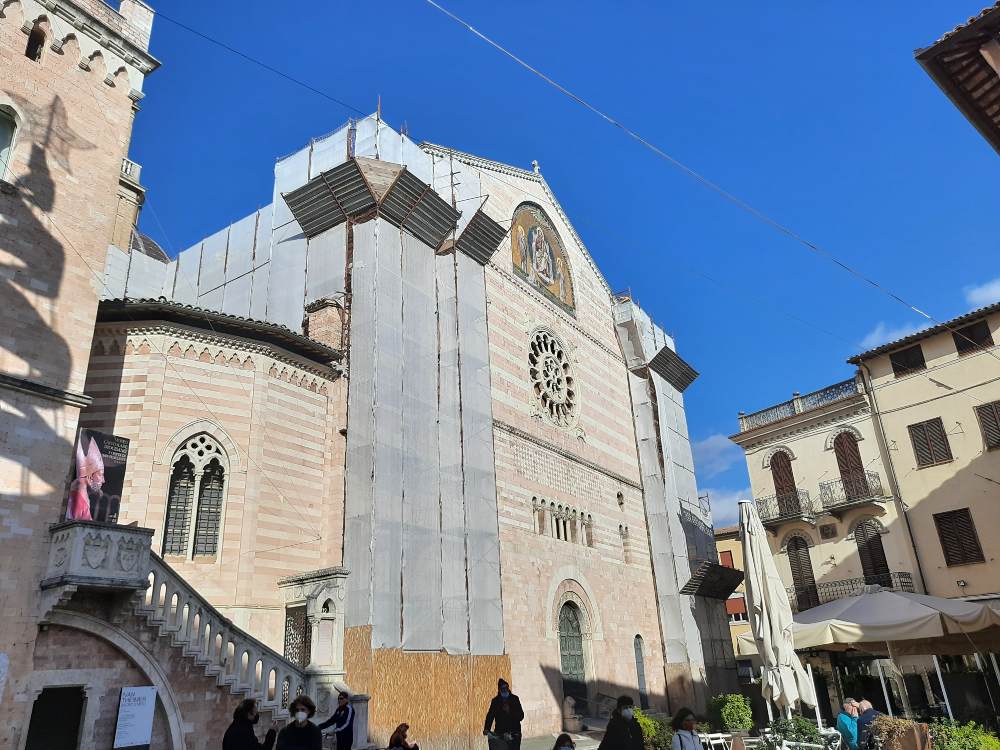
The city Cathedral, dedicated to San Feliciano, is a masterpiece of Umbrian Romanesque built starting from 1113 on the site of the saint’s martyrdom. The church has the particularity of having two facades finely sculpted by the masters Rodolfo and Binello. The interior, redesigned by Giuseppe Piermarini based on a design by Luigi Vanvitelli, is striking for the sumptuous bronze canopy above the main altar. Two extraordinary marble busts sculpted by Gian Lorenzo Bernini portraying Bartolomeo and Diana Roscioli were rediscovered in the sacristy, treasures now linked to the Diocesan Museum.
@RebeccaManzi/GreenMe
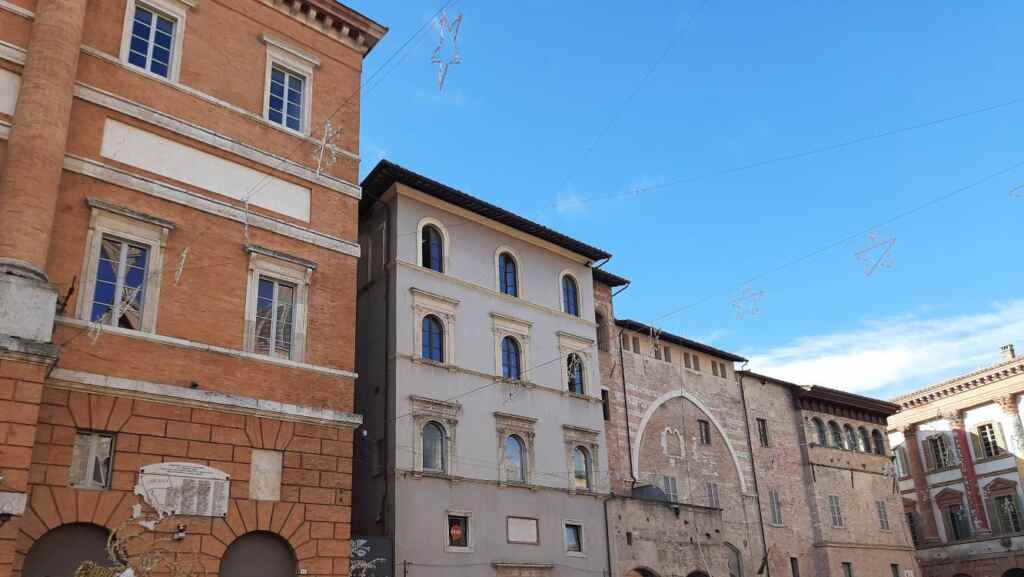
The Printing Museum at Palazzo Orfini
Foligno boasts an extraordinary editorial record: here on 11 April 1472 the German craftsman Johannes Numeister, a pupil of Gutenberg, together with the paper evangelist Emiliano Orfini, printed the first ever copy of Divine Comedy by Dante Alighieri. Inside Palazzo Orfini we visited the Printing Museum, an interactive journey that winds through fifteenth-century presses, evidence of the historic local paper mills and a precious original page of the Comedy in which the great poet describes the Umbrian landscape.
@RebeccaManzi/GreenMe
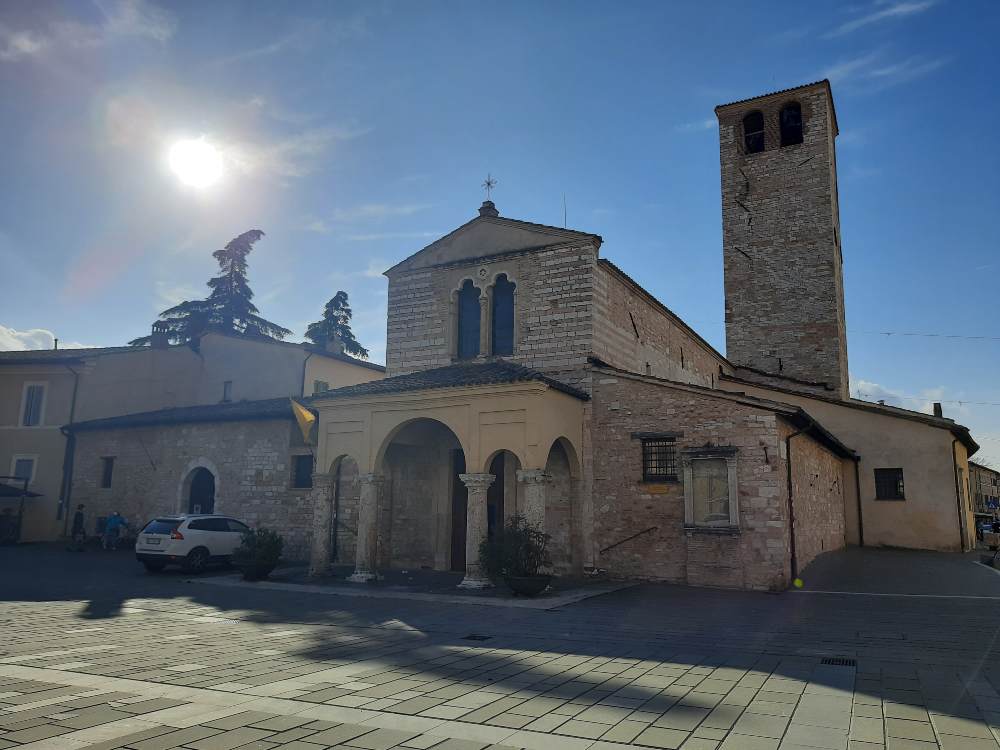
Church of Santa Maria Infraportas
In Piazza San Domenico stands the Church of Santa Maria Infraportas, one of the oldest religious buildings in the city, built in Romanesque style. Its curious name derives from the fact that, following the expansion of the city walls in the 14th century, the building found itself positioned right between the old and new defensive gates. Inside you can admire splendid examples of Umbrian devotional painting, including the frescoes of the Madonna del Latte by Giovanni di Corraduccio and the intense depictions of the Crucifixion created by the master Niccolò Alunno.
@RebeccaManzi/GreenMe
Goodbye to the “center of the world”
Leaving Foligno means taking with you the surprising contrast between the medieval silence of its alleys and the magnetic provocation of contemporary art. It is a city that does not show off with the altitude of the Umbrian hills, but which prefers to conquer those who cross it on foot, one detail at a time, revealing a cultural richness that has few equals in the region. If you are looking for an Umbria outside the usual circuits, authentic and vibrant, just follow the Topino and let yourself be guided by the slow pace of this splendid city.
