
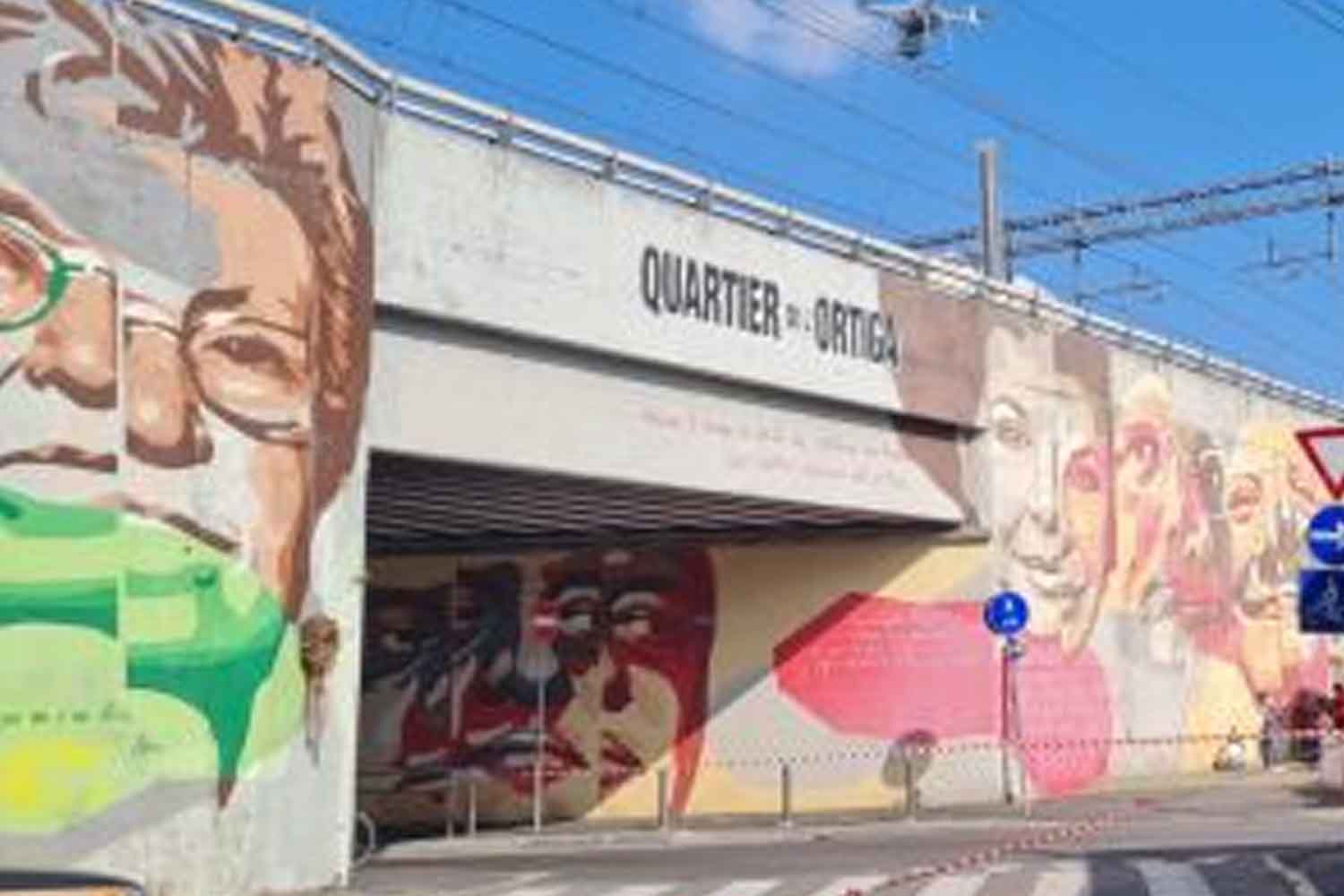
What happens to the murals over time? Those that we photograph every day on the street, which transform anonymous walls into open -air canvases, are much more fragile than we think. Smog, rain, sun, pollution, even the materials chosen to paint them: everything affects their duration. But now a new Italian study has shed light on an often ignored detail – the colors are not all the same.
And it’s not just aesthetic. Behind this research there is a real conservation strategy, useful not only for artists, but also to those who want to protect them, restore them and keep them alive over time.
Lunge murals? Just choose the right pigments
To conduct the study was a group of researchers from the University of Pisa, the CNR and the University of Perugia, within the Superstar project (Sustainable Preservation Strategies for Street Art). The chosen study case is the mural Popular music of the Orticanoodles collective, almost 400 meters long, built in 2017 in the Ortica district of Milan. There they appear historical faces of Milanese culture such as Giorgio Gaber, Ornella Vanoni, Dario Fo and Enzo Jannacci.
Using advanced scientific techniques – as multispectral reliefs with drones, laboratory chemical analyzes and hyperspectral imaging – researchers measured how much and how colors change over time.
The result? Red, in particular what contains the pigment PR112, is the most fragile color: it tends to disclose and deteriorate in a short time. On the contrary, purple and yellow have proven to be much more stable and resistant. Even black and gray maintain their intensity better.
It is not just a question of pigment, however. Even the binders used in paints (i.e. the resins that hold the color together) count a lot: acrylic or shameless resins, especially in the presence of titanium dioxide, can lose brightness and disintegrate.
How the technology that analyzes murals works without ruining them
To study the Milanese mural, the team has put together different technologies. Hyperspectral images captured with drones allow you to monitor the status of colors without physically touching the work. It is a non -invasive, faster and cheap system compared to traditional restoration methods, and has a huge advantage: it can also be used on large murals, in Italy and abroad.
“This information is precious for those who deal with conservation,” explains Laura Cartechini of the CNR-Scitec. The new method, adds, “is more sustainable for local administrations and allows you to build a real chronology of the degradation of the works “.
And this can really make a difference. “The results are promising,” adds Aldo Romani, director of the Smart Center of the University of Perugia. The goal? Understanding in advance when to intervene, how and where, avoiding that the murals disappear into thin air.
From Banksy’s “Girl With Balloon” to Jorit’s murals
This discovery is not only for scientists or restorers. It concerns anyone who loves street art. Think about the famous Girl with Balloon Banksy: over the years, the red balloon could have disappeared, while the black silhouette of the child would remain intact. Or to the hyper -realistic faces of Eduardo Kobra or Maradona designed by Jorit in Naples: understanding which pigments to use means protecting them better, from the beginning.
And thanks to science, it is now possible to monitor and preserve these works more effectively and sustainable. Nicola Masini of the CNR-ISPC also underlines it:
With the hyperspectral data from drone we can obtain precise information, at low costs and quickly. It is a fundamental step forward for the conservation of street art.
The study does not only save colors, save memory. Protects the stories, complaints, celebrations and emotions enclosed in the murals. Now, thanks to scientific research, we have the tools to prevent these urban stories from disappearing in the rain or the scorching sun. And the first step starts from the palette.
You may also be interested in:
