
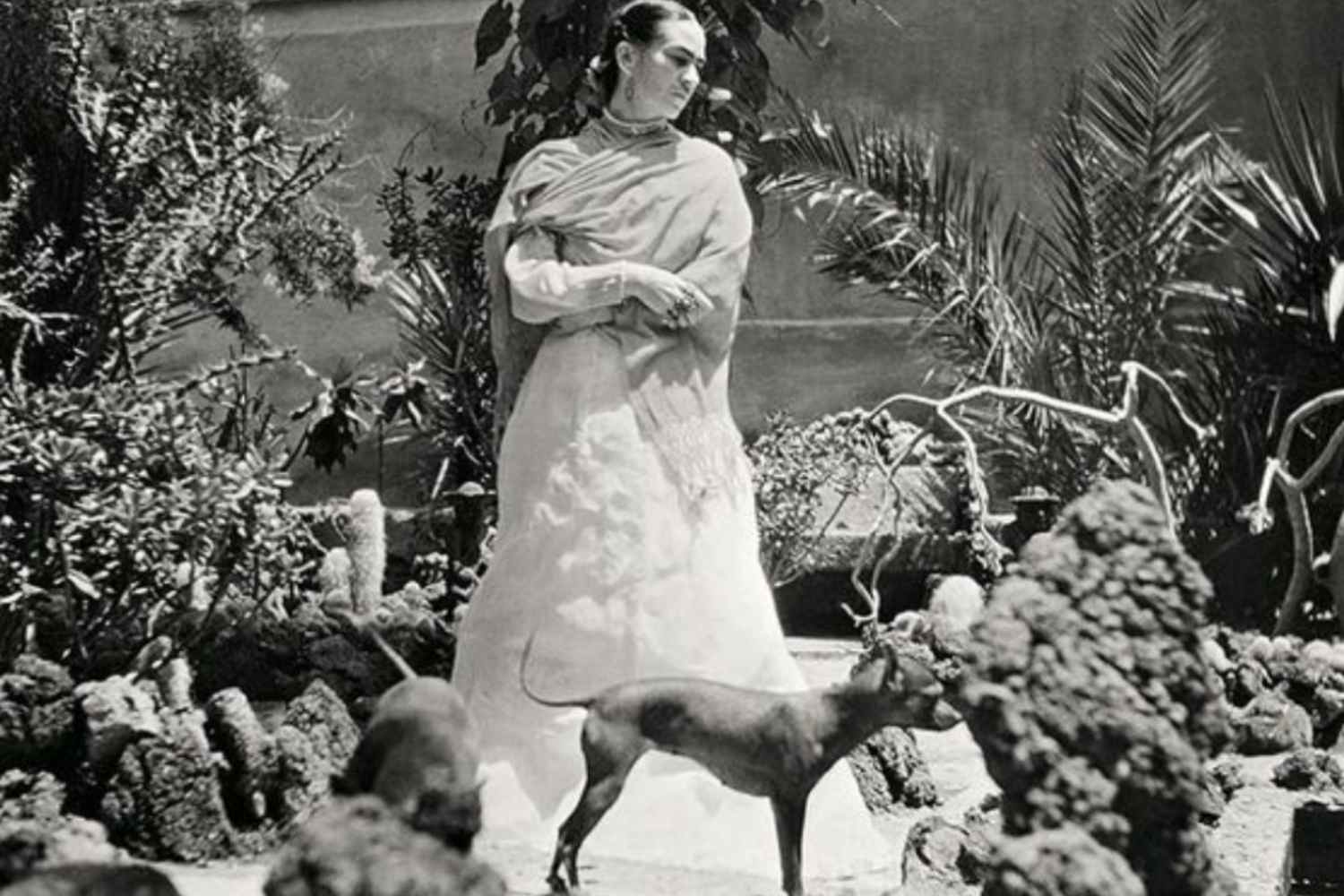
When you think of Frida Kahlo, thick eyebrows, self-portraits and traditional Mexican clothing immediately come to mind. Yet there is another element that runs through much of his life and artistic production: animals.
Monkeys, hairless dogs, parrots, deer, ducks and even an eagle. The Mexican painter didn’t just love them: she literally lived surrounded by them in her famous Casa Azul in Coyoacán, now transformed into the Frida Kahlo Museum. Even today, photographs, documents and testimonies tell of a daily coexistence that went far beyond the simple ownership of pets.
A house that looked like a small nature sanctuary
The garden of the Casa Azul was home to a surprising variety of animals. Among the best known were spider monkeys, various parrots and the xoloitzcuintli, the ancient hairless Mexican dog breed. Frida and Diego Rivera shared this passion and numerous photographs show them together with their favorite animals.
According to various biographical reconstructions, deer, tropical birds, ducks and other animals also lived in the house and contributed to creating a unique environment, halfway between a domestic garden and a creative refuge.
The monkeys who become life companions
View this post on Instagram
Among all animals, monkeys occupy a special place. They appear in some of his most famous self-portraits, often clasped around his shoulders or close to his face.
In works such as Self-portrait with monkeys the animals almost seem to protect her. They are not decorative figures but affective presences, represented with a sensitivity that reveals a strong emotional bond. Scholars have often interpreted these figures as symbols of the companionship and affection that Frida sought in a life marked by long periods of physical suffering and isolation.
The sacred dogs of Mexico
View this post on Instagram
Among the animals Frida loved most were the xoloitzcuintli, a breed with very ancient origins that has its roots in the Aztec civilization.
Among all, one of the most loved was Señor Xólotl, a dog of the Xoloitzcuintle breed. It is one of the oldest breeds on the American continent, originating from pre-Columbian Mexico. The name chosen by Frida was not random: it recalled Xólotl, a deity from Aztec mythology associated with death, transformation and the journey of souls to the afterlife. The painter, deeply fascinated by indigenous culture and pre-Hispanic traditions, saw in this animal a direct connection with the most ancient roots of her country.
In pre-Hispanic tradition these dogs were considered guides of souls on the journey to the afterlife. For Frida and Rivera they also represented a strong reminder of the Mexican cultural identity and indigenous traditions that they both deeply valued. In several photographs of the Casa Azul the painter appears together with her xoloitzcuintli, who she considered true life companions.
A refuge against pain
Frida’s passion for animals takes on an even deeper meaning when included in her biography. Since childhood she had to live with health problems, aggravated by the terrible road accident in 1925 which caused permanent injuries.
For long periods she was forced into immobility and spent months in hospitals and convalescing. Animals represented a reassuring and constant presence in a life marked by physical suffering. Many biographers point out that the natural world was a source of comfort, companionship and artistic inspiration for her.
Much more than just pets
View this post on Instagram
In Frida Kahlo’s paintings, animals are never simple extras. They become symbols, alter egos, silent guardians of his emotions and his identity.
Perhaps this is also why, more than seventy years after her death, the images portraying her with a monkey on her shoulder or with a dog at her feet continue to fascinate the public. They tell a different Frida from that of art history books: more intimate, more vulnerable and, precisely for this reason, more human.
