
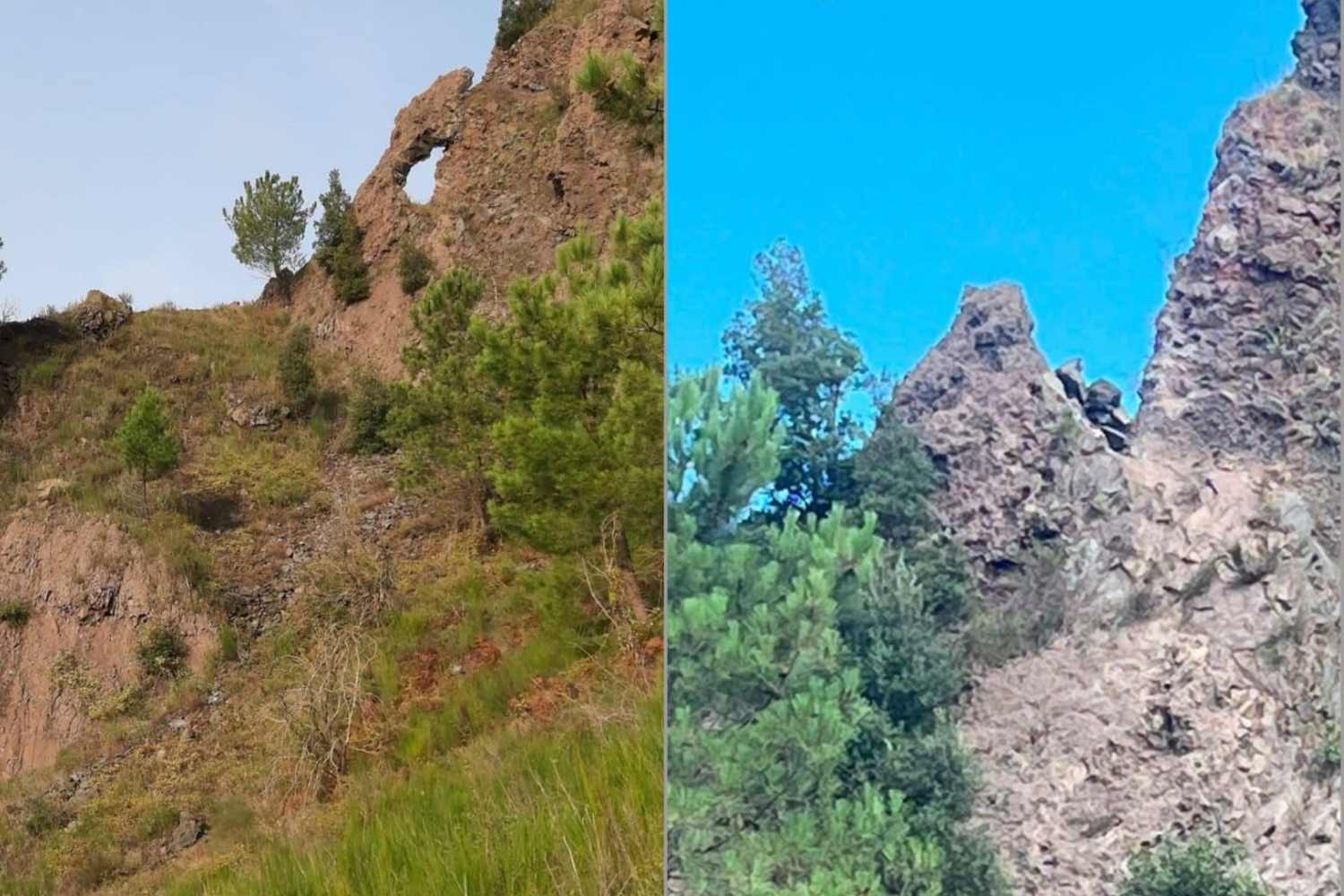
An iconic element of the volcanic landscape of Campania has crumbled forever. The rock arch known as the Devil’s Eye, located in the Vesuvius National Park, has collapsed irremediably. The discovery was made on the morning of August 17 by Giuseppe Miranda, patron of the Vesuvio Ultra Marathon race, during his usual walk along the Vallone dell’Arena path, in the heart of the Valle dell’Inferno.
The rocky arch overlooked the geological structure known as a lava dike, in the internal offshoots of the ancient Monte Somma. Confirmation came from Vincenzo Marasco, civil protection operator, environmentalist and president of the Nicolò d’Alagno historical study center in Torre Annunziata, who documented the event by comparing a shot taken in spring with a photograph taken after the collapse.
The causes of structural failure in the lava dike
The natural failure of the Devil’s Eye was not a sudden event, but the outcome of a prolonged process. The erosive action of atmospheric agents, such as gusts of wind and precipitation, combined with the constant seismic activity that characterizes the structure of Vesuvius, has progressively weakened the fragile and exposed rock. Marasco explained the dynamics of what happened on social media:
The hole that opened in the internal offshoots of the ancient Monte Somma, in the lava dike that overlooks the Vallone dell’Arena inside the Valle dell’Inferno and which we frequent visitors to the mountain commonly referred to as the ‘devil’s eye’, as noted by Dr. Giuseppe Miranda, patron of the Vesuvio Ultra Marathon during his usual morning excursion, no longer exists this morning.
The impact on the naturalistic heritage of the Valle dell’Inferno
The rock formation represented a point of reference for hikers and researchers engaged in the study of the volcanology of Monte Somma. Its natural cavity offered a unique visual opening onto the austerity of the volcano’s internal landscape. Evaluating the symbolic value that the cavity had for the local community and for the environmental history of the Torre Annunziata area, Marasco reiterated:
The slow and inexorable degradation of the most fragile and exposed geological aspects of the ‘Sleeping Mountain’ has taken its natural course. We will miss that gaze fixed on those who followed the paths that cross the austerity of the naturalistic context of the Valle dell’Inferno.
