
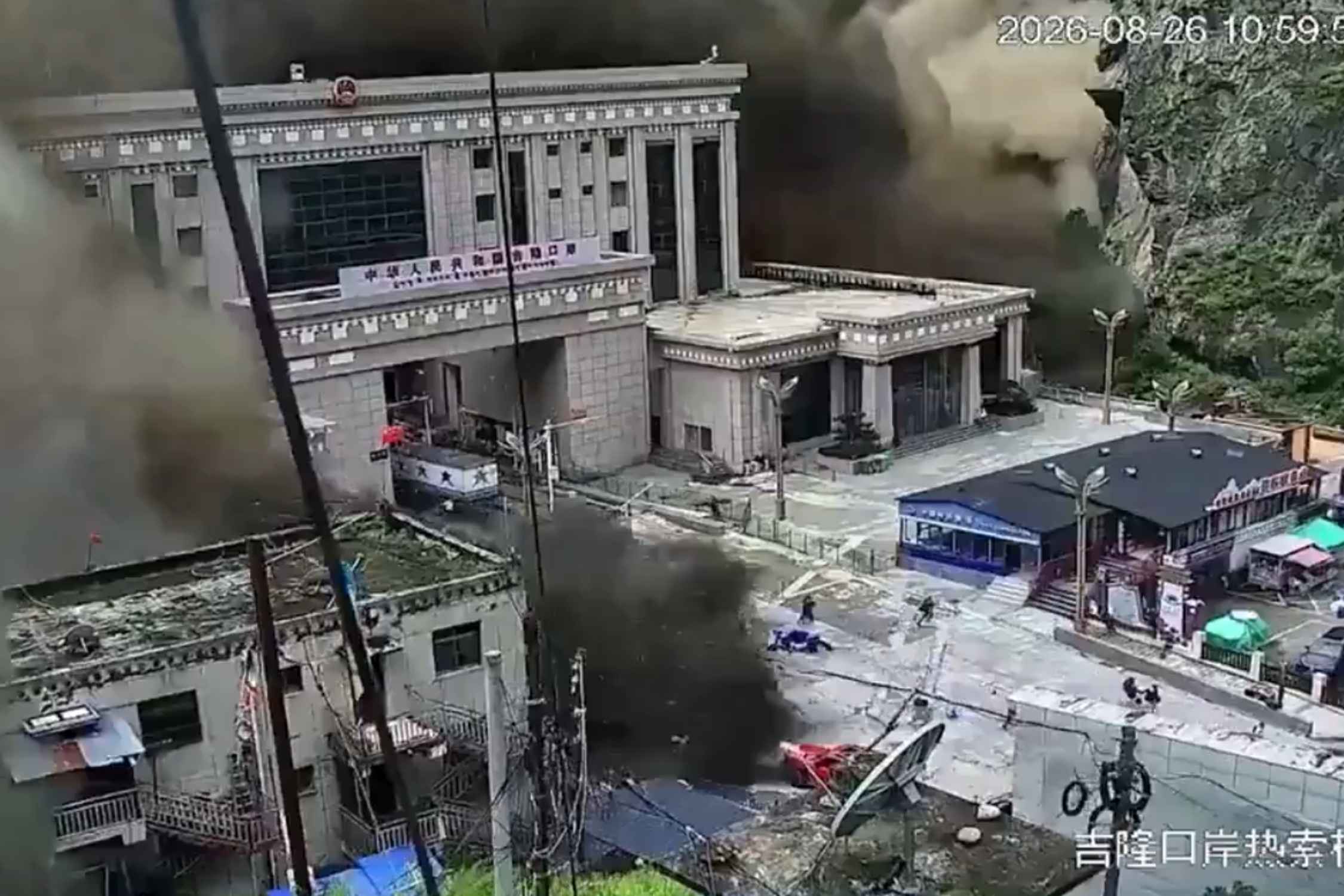
The Bhotekoshi River has flooded twice in just over a year. The first in 2025, with 18 deaths after the collapse of a glacier on the Chinese side of the border. The second on Wednesday, with a toll that the sources update hour by hour: the Kathmandu Post speaks of 22 confirmed victims and 384 people still nowhere to be found, of which 291 foreign citizens and 32 members of the security forces.
According to reports from AFP and Reuters, Nepalese police said the death toll from the floods had risen to 95. The Nepal Tourism Board added that the number of missing was 403, including 341 foreigners. It is not a statistical coincidence that the same mountain repeats itself: it is an unstable glacier that continues to collapse in the same place.
Planet Labs को स्याटेलाइट तस्बिरको विश्लेषणका आधा3 गरिएको प्रारम्भिक अध्ययनबाट नेपाल-चीन रसुवागढी नाकाबाट करिब २० किलोमिटर उत्तरपूर्व नेपाल-चीन सिमानामा गएको हिम-चट्टान पहिरोका कारण ल्हेन्दे खोलामा गेग्य्रानसहितको बाढी आएको देखिएको छ। pic.twitter.com/kCAo9O1Zb0
— NDRRMA (@NDRRMA_Nepal) August 26, 2026
“Damage of this magnitude has never occurred”
The scale of the devastation was described by Krishna Prasad Humagain, deputy head of the Nuwakot district, who told the Kathmandu Post: “Entire settlements were razed to the ground, while banks, bridges and markets suffered extensive damage.” And he added: “Damage of this magnitude has never occurred in history.” Dozens of concrete bridges were swept away, communications interrupted, rescue operations slowed by bad weather.
A horrific scene of severe flooding at the Rasuwagadhi border point on the Nepal-Tibet border.
The strong currents wreaked havoc across the area, leaving 400 pilgrims and 105 Indian tourists also missing in the Nepal floods.#NepalFloods #Nepal #Rasuwa #FlashFlood #Floods pic.twitter.com/dwAX12Gj7l—Ravi Pandey (@ravipandey2643) August 26, 2026
Drones and special forces on the trail of the missing
According to what was reported by Nepal News and reported by ANSA, the Nepalese army, the police and the Armed Police Force are participating in the search operations, supported by specialized personnel, medical teams and emergency management vehicles. Emergency supplies are being sent to the affected areas, while drones are being used to map the damage and locate any isolated people. Rescuers are concentrating their searches in particular in the areas of customs and the Rasuwagadhi airport, where some people may have remained buried.
View this post on Instagram
A construction site completed two days before the disaster
Among the silent victims of the flood are the workers of the Langtang Khola hydroelectric project, a 20 megawatt plant. Bijay Mohan Bhattarai, promoter of the project, reported to the Kathmandu Post that the plant was already completed, with tests scheduled for two days: “So far we have not been able to contact them,” he said on Wednesday afternoon, speaking of the 60 workers who remained without contact – twenty-five engineers, drivers and kitchen staff, plus 35 workers who were inside a tunnel. Added to these are the 15 employees of the Rasuwa customs office in Timure, according to Rajendra Dhungana, head of the customs office.
Ninety Italians in the region, two involved
According to ANSA, around ninety Italians are present between Nepal and Tibet based on the registrations on the “Where we are in the world” portal. Foreign Minister Antonio Tajani, speaking on the sidelines of the Communion and Liberation Meeting in Rimini, specified that the Italians involved in the flood “are two and they are fine”: “We are in contact with them and their families. We are following the path so that they can return to Italy in the best possible way. But, in short, we don’t see that there are any problems for other Italians”, he said. The Foreign Ministry’s Crisis Unit is in contact with the consulate general in Kolkata, the honorary consulate in Kathmandu and the embassy in Beijing to verify the possible involvement of further compatriots.
Rescue services, including helicopters and weather emergencies
The Nepalese army rescued 88 people, said spokesman Rajaram Basnet: thirteen were admitted to the Tribhuvan university hospital in Kathmandu, the others transferred to safe places or assisted in the Trishuli camp. Twelve helicopters, four military and the other private, are engaged in the operations: according to the rescue coordination center at Tribhuvan airport, 29 private and six military flights were carried out towards the flooded areas, of which 23 private and two military personnel returned with injured people on board.
A risk that is repeated on the same side
What makes the story even more serious is its repetition: the same area of the Nepal-Chinese border had already collapsed a year ago, with a death toll of 18 after the collapse of a glacier on the Chinese side. Rasuwa is located along one of the main trade routes between Nepal and China, today interrupted along with electricity and telecommunications: the same geography that makes that valley strategic for trade exposes it, every time the ice upstream gives way, to a wave that arrives without warning.
