
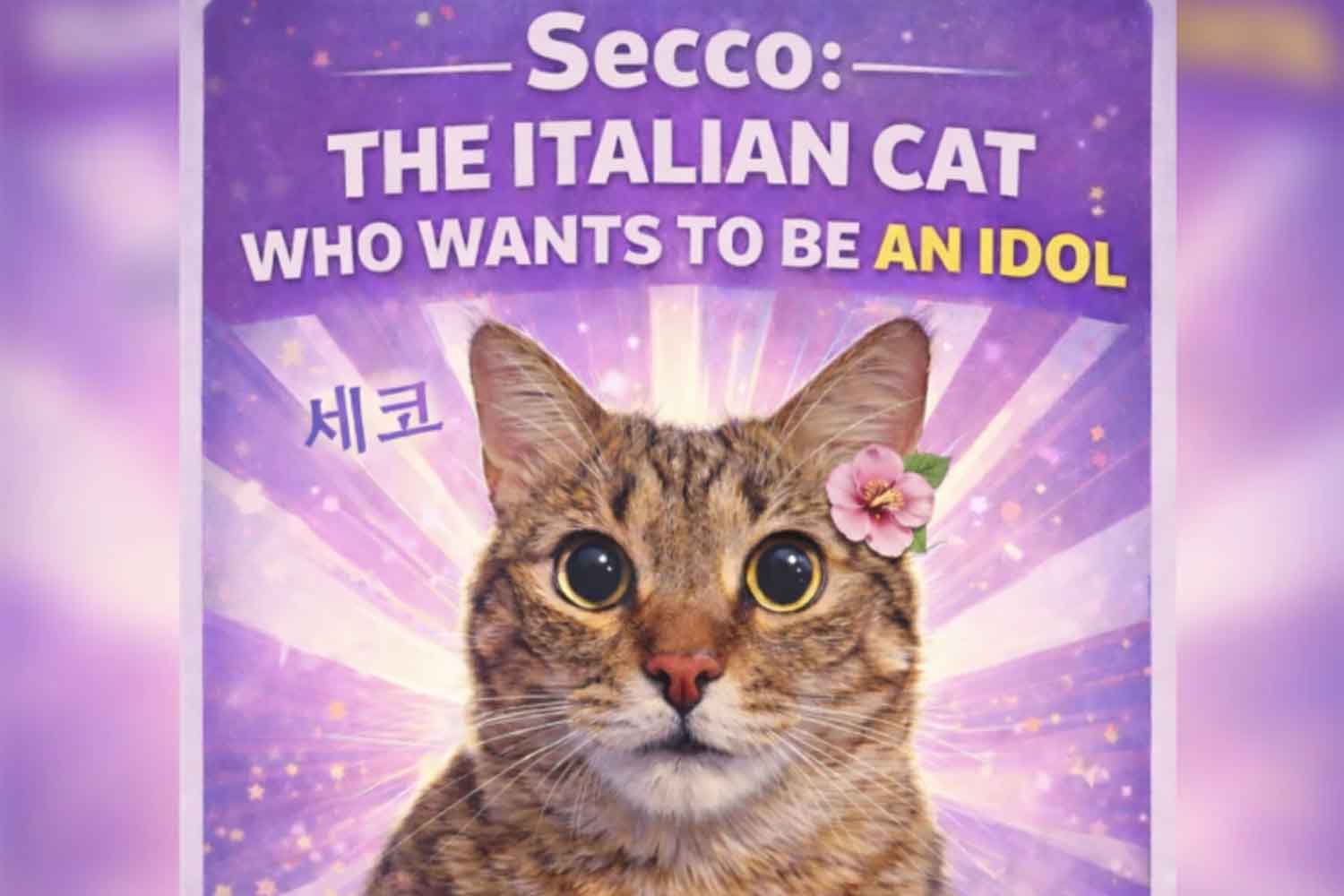
The first serious clue is the name written in Korean: 세코. Then comes everything else: an Italian cat with the face of a silent protagonist, a Roman sofa, K-Dramas on the screen and a social profile that presents itself as The First Cat Idol.
Secco was born in Molise, lives in Rome and chose a decidedly unusual path to enter Korean pop culture: not a stage, not a talent show, but the living room at home. Its story comes from the project TailsandKDramaa narrative game that mixes the world of Korean fandom with the equally powerful world of cat lovers.
Because in the end, very little is enough: a cat staring at the television with a concentrated expression, a quote from a K-Drama and suddenly that face becomes that of a possible “idol”
View this post on Instagram
Secco, K-Wave’s laziest trainee
In the world of K-Pop, a trainee is an artist in training: he spends years training before his debut, including singing, dancing, discipline and building a public image. Secco, on the other hand, follows a much more feline path.
His preparation mainly consists of looking at the screen critically, choosing when to give attention to humans and occupying the best place on the sofa. And perhaps this is precisely the secret of the project: it takes the language of fandom seriously, but takes it into completely absurd territory.
References to Korean culture appear on his profile: from gat, the traditional Korean hat, to tteokbokki, the popular dish based on rice cylinders in spicy sauce, to references to BTS and K-Dramas.
Secco doesn’t become a character because he does something extraordinary. He becomes a character because he does what all cats do: he observes the world as if he were the protagonist.
View this post on Instagram
K-Wave enters the living room
Secco’s story comes at a time when South Korean culture has now firmly entered the habits of millions of people. The so-called Hallyu, that is, the global diffusion of Korean pop cultureis no longer just about K-Pop: it involves TV series, cinema, cooking, fashion, beauty and even language.
According to data released in 2025 by the South Korean Ministry of Culture and KOFICE, K-Pop remains the element most associated with South Korea, followed by food, drama, beauty and cinema. In Italy this influence came mainly through platforms such as Netflix, YouTube and Spotify: first a series, then a song, then a recipe or a word learned from the subtitles.
Secco does a simple thing: he brings all this into an everyday scene. There is no lit stage. There is no perfect choreography. There is a cat on the sofa looking at a screen. And it is precisely this normality that makes the project so recognisable.
View this post on Instagram
The strength lies precisely in the small scale. Secco doesn’t explain K-Wave from above. He crosses it with a paw on the remote control. It makes it familiar, funny, accessible. Light content can become a small gateway: first you laugh at the cat, then you understand the reference, then maybe you look for the drama, the dish, the Korean word.
Do cats really look at screens?
The question, at least once, comes spontaneously: do cats really watch TV? In part yes, although no one can know for sure what they think they see. We have already explained that some cats are attracted to screens because they distinguish shapes, patterns and textures, especially when there are rapid movements or interesting sounds. The screen can therefore be a stimulus, even if it should be thought of as a short-term enrichment, together with real play, space and interaction.
Secco remains credible because he remains a cat. There’s no need to imagine that it actually follows the plot of a K-Drama. Movement, habit, the human gaze are enough to transform a pose into a story. Anyone who lives with a cat knows the mechanism well: a more intense face than usual and we have already written three seasons, a prequel and a final scene in the rain.
The debut has already happened
A small feline crew also moves around Secco: Jedi, Ambra and Fuffola. Everyone has a role, a presence, a narrative possibility. The project takes the grammar of fandoms – characters, catchphrases, symbolic objects, recurring phrases – and passes it through animals that by nature sabotage every human plan with a yawn.
Maybe Secco will never go on stage in Seoul. Perhaps he will simply continue to sleep, watch, ignore requests and appear whenever he wants. But the debut, in miniature, has already happened: in the comments, in the shared posts, in the way in which a community recognizes the game and enters it without instructions. The K-Wave has arrived here too: between a bowl, a Roman sofa and a Molise cat convinced it deserves a dressing room.
