
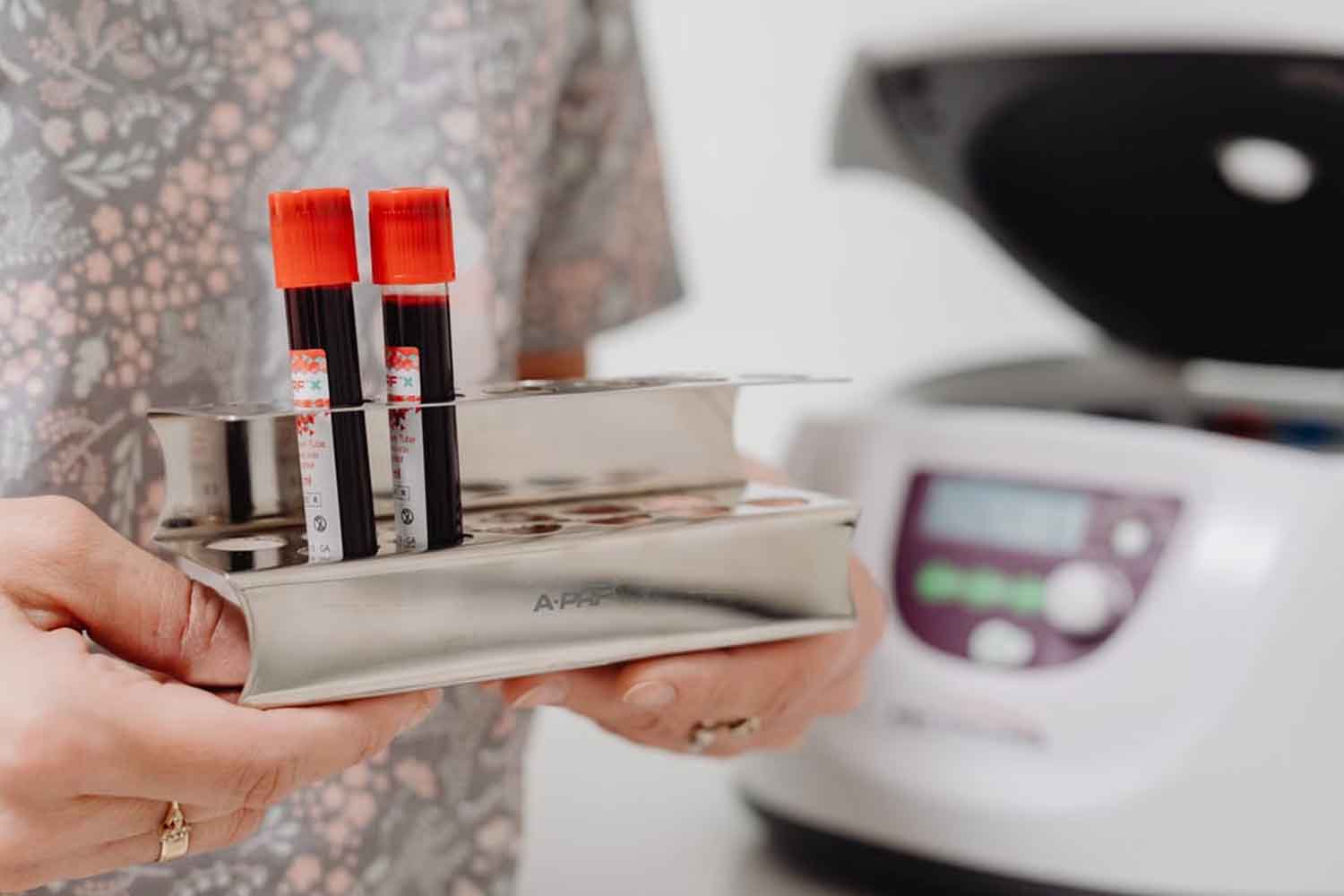
A simple blood test can help doctors understand if there are amyloid plaques associated with Alzheimer’s in the brain. In the United States, the FDA has given the green light to PrecivityAD2, a test intended for adults aged 40 and over who already have memory problems or other cognitive symptoms.
The clarification is important: it is not a screening test for healthy people and is not used to know today whether we will develop Alzheimer’s in twenty years. It is used when symptoms have already appeared and doctors are trying to understand the cause. The FDA also specifies this.
What the test looks for in the blood
PrecivityAD2 was developed by C2N Diagnostics, a company born out of the Washington University School of Medicine in St. Louis. The test looks for certain substances in the blood linked to Alzheimer’s disease. In particular, it measures two types of beta-amyloid and a particular form of the tau protein. These values are then combined to estimate the probability that amyloid plaques are present in the brain. Simply put: blood contains some signals that can indicate what is happening in the brain.
Until now, to check for the presence of amyloid, we mainly use brain PET, a specific scan, or analysis of cerebrospinal fluid, which requires a lumbar puncture. The new test therefore aims to make this step much simpler. Washington University School of Medicine explains that PrecivityAD2 showed results similar to those obtained with these more complex tests.
How accurate is PrecivityAD2
The study used to evaluate the test involved 1,142 people with symptoms of cognitive decline. Of those who tested positive, 97.6% actually had amyloid plaques according to PET or cerebrospinal fluid analysis. Among those testing negative, the negative predictive value was 93.1%.
However, there is also an intermediate area. In some cases the result is classified as “probably positive”, so the test does not always give a clear answer. Medicine, every now and then, stubbornly refuses to function like a traffic light.
From the age of 40 yes, but only if there are already symptoms
The 40 year figure can easily be misleading. The test is not intended for anyone above that threshold. PrecivityAD2 is intended for people who already have problems with memory, language, orientation or other cognitive difficulties and who are undergoing medical treatment to understand what causes them.
Furthermore, a positive result alone is not enough to diagnose Alzheimer’s. Doctors continue to also consider the patient’s medical history, cognitive tests, neurological examination and, when necessary, other tests. The Alzheimer’s Association also makes it clear: the test is a support tool, not a complete diagnosis made from a test tube.
Because it can be useful
The most obvious advantage is practical. A blood draw is much easier to arrange than a PET scan and less invasive than a lumbar puncture. This can help doctors arrive at a more precise assessment sooner, especially in the early stages of the disease.
Today there are also drugs, such as lecanemab, used in some patients with early Alzheimer’s. These treatments do not cure the disease, but they can slow its progression in select people. To use them you need to confirm the presence of amyloid in the brain.
PrecivityAD2 can therefore become one of the useful tools to shorten the diagnostic path. For now the most concrete change is all in a test tube: to look for one of the main biological signs of Alzheimer’s, a blood sample may be enough. The complete diagnosis remains much more complex, and continues to be the responsibility of doctors.
